

PRACTICAL CORPORATE COMPLIANCE GUIDE
Companies Act, 1994 | Registrar of Joint Stock Companies and Firms (RJSC)
Schedule X is the annual summary of share capital, shareholders and directors filed with the Registrar of Joint Stock Companies and Firms (RJSC). In Bangladeshi practice it is commonly referred to as the annual RJSC return. Its statutory foundation is section 36 of the Companies Act, 1994, and for a private company it is one of the most important recurring corporate-compliance filings.
| At a glance Legal basis: Companies Act, 1994, section 36. | Return date: generally the date of the AGM. | Filing deadline: within 21 days after the AGM. | Core content: share capital, paid-up/called-up position, shareholders and transfers, directors/management/auditor, and registered mortgages/charges. | Practical name: annual RJSC return (although the wider annual-return package also includes the financial statements and Form 23B). |
If you need help in preparing and submitting Schedule X/Annual RJSC return, FMG Chartered Accountants is here to help. You can contact us through whatsapp (01677 970763) or email us at info@fmgaccountants.com.
1. What is Schedule X?
Schedule X is the prescribed annual statement through which a company with share capital reports its capital structure and the persons connected with that capital as at the relevant annual general meeting. The form is headed “Annual Summary of Share Capital and List of Shareholders” and also captures directors and certain other officers. The official RJSC form expressly refers to section 36 of the Companies Act, 1994.
The filing is more than a list of current shareholders. Section 36 requires information about current and former members since the previous return, share transfers, called-up and paid-up amounts, share warrants and forfeitures where applicable, directors and changes, and debts secured by mortgages or charges that are required to be registered with RJSC. For a private company, section 36 also requires an additional certificate confirming that the company has not invited the public to subscribe for its shares or debentures, together with a further certification where the reported membership exceeds the private-company limit because of statutory exclusions.
A useful way to think about Schedule X is as a year-end corporate register reconciliation prepared on the AGM date. If the Register of Members, share allotment records, transfer records, director filings and charge records do not agree with Schedule X, the annual return is vulnerable to query or rejection.
2. Legal basis and filing deadline under the Companies Act, 1994
Section 36 applies to every company having share capital. The first annual list is required within 18 months after incorporation, and thereafter at least once every year. The list is prepared in the prescribed Schedule X form by reference to the members on the date of the first or only general meeting of the year. RJSC’s official guidance describes Schedule X as an annual return to be filed within 21 days of the annual general meeting (AGM).
Section 81 is relevant because it governs the AGM calendar. It requires an AGM in every Gregorian calendar year and generally prevents more than 15 months from passing between two AGMs. A first AGM may be held within 18 months after incorporation. Accordingly, the company’s AGM timetable and its Schedule X filing calendar are directly connected.
| Critical date rule The “made up to” date in Schedule X should be the relevant AGM date, not automatically the financial year-end. If the AGM is held on 30 June 2026 for accounts ending 31 December 2025, the Schedule X return date is 30 June 2026 and the 21-day filing period runs from that meeting date. |
Section 36(3) also contains signing and certification requirements. In statutory terms, the filed copy and certification are to be signed by the prescribed directors/officers, including the managing director where the section so requires. The current RJSC system generates the filing and signature blocks electronically, so the filer should follow the portal-generated document while ensuring that the section 36 certification is not overlooked.
3. Documents and records to collect before preparing Schedule X
Preparation should start from the company’s statutory records, not from last year’s Schedule X alone. The previous return is a comparison document; it is not the primary evidence. Collect and reconcile the following records before entering data:
- Certificate of Incorporation and the current Memorandum and Articles of Association, including any capital clause amendments.
- The latest approved Schedule X and the company’s Register of Members maintained under section 34.
- Share allotment records and Form XV filings, together with board resolutions and share application/allotment documentation.
- Share transfer instruments, board approvals, registration dates and updated share certificates or share ledger entries.
- Records of any increase, consolidation, subdivision or other alteration of share capital and the related RJSC filings.
- Latest Form XII and any documents supporting appointment, resignation or change of directors, manager or managing agent.
- AGM notice, attendance records and signed AGM minutes establishing the return date.
- Register of Charges and the latest Form XVIII, Form XIX or satisfaction documents for mortgages/charges, where applicable.
- Records supporting called-up capital, amounts received, calls unpaid, non-cash allotments, commission/discount, forfeited shares or share warrants if any.
- Auditor appointment details and the current auditor’s name and address for the return date.
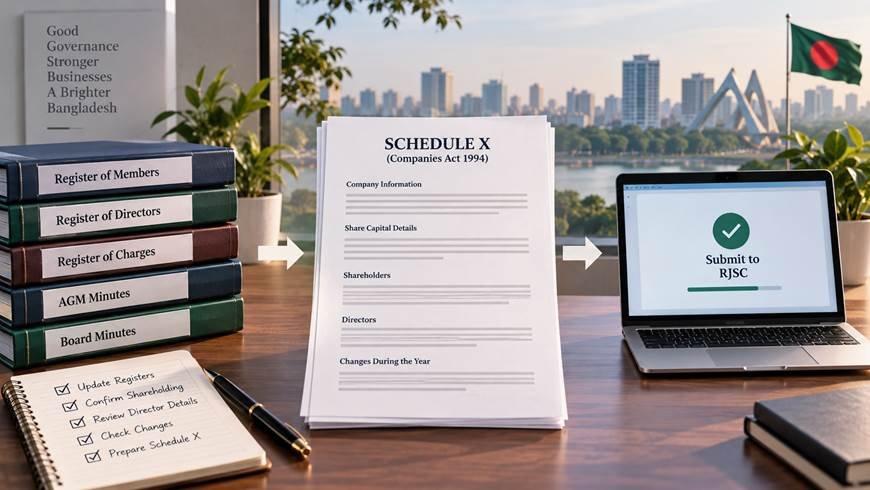
A reliable Schedule X begins with statutory-register reconciliation before portal submission.
4. Understanding the information required in Schedule X
The official Schedule X is detailed. For most private companies with a simple ordinary-share structure many fields will be zero or not applicable, but each item should still be reviewed. The following practical map follows the prescribed form and section 36 requirements.
| Item | What Schedule X asks for | Practical preparation point |
| 1-4 | Shares taken up; cash and non-cash issues; partly paid non-cash shares. | Reconcile to allotment records, Form XV and the current member register. |
| 5-7 | Amounts called up on each class of shares. | Separate share classes or different call levels where relevant. |
| 8-12 | Amounts received on calls/application; amounts treated as paid; calls unpaid. | Reconcile issued, called-up and paid-up capital to the company’s accounting and share records. |
| 13-14 | Commission/discount on shares or debentures; forfeited shares and money paid thereon. | Use nil only after confirming that no such transaction occurred since the last return. |
| 15-17 | Outstanding share warrants; warrants issued/surrendered; shares or stock represented by each warrant. | Usually nil for a conventional private limited company, but verify rather than assume. |
| 18 | Debt due in respect of registered mortgages/charges. | Reconcile the amount outstanding with the Register of Charges and registered charge documents. |
| 19 | Current shareholders and persons who held shares since the last return, with transfers. | Show current holdings and transfer particulars; include persons who ceased to be members after the last return. |
| 20 | Directors as at the return date. | Reconcile names and addresses with the latest director records/Form XII. |
| 21 | Managing director/manager/managing agent/auditor details and relevant changes. | Ensure the return reflects the position on the AGM date and identifies changes since the preceding return where required. |
5. Step-by-step: how to prepare Schedule X correctly
1. Fix the return date from the AGM. Confirm the date on which the AGM was actually held. This is normally the date to which Schedule X is made up. Keep the signed AGM minutes in the working file.
2. Reconcile nominal/authorised capital. Confirm the current authorised share capital and number/value of shares from the Memorandum and any registered capital alteration. If there are different classes or nominal values, present them separately.
3. Reconcile issued, taken-up, called-up and paid-up capital. Start with the previous return, add valid allotments, adjust for capital alterations and confirm amounts called and received. The total shares taken up must agree with the aggregate shares held by current members on the return date.
4. Prepare the shareholder movement schedule. For each shareholder, identify opening holding, allotments, transfers in, transfers out and closing holding. Record transfer registration dates. Persons who ceased to be members after the last return must not simply disappear; Schedule X requires the relevant historical information.
5. Reconcile directors and officers. Compare the preceding return with Form XII and board records. Ensure directors’ names/addresses and any managing director, manager, managing agent or auditor information reflect the return date. An annual return does not cure a missing change filing.
6. Reconcile mortgages and charges. Identify all charges required to be registered and determine the amount of debt outstanding at the return date. Compare this against the Register of Charges and prior Forms XVIII/XIX and satisfaction filings.
7. Review unusual share-capital fields. Check whether there were non-cash allotments, partly paid shares, calls in arrears, commissions, discounts, forfeitures or share warrants. Do not leave these items unreviewed merely because they are uncommon.
8. Prepare the private-company certificate. Confirm that since the previous return—or since incorporation for the first return—the company has not issued an invitation to the public to subscribe for its shares or debentures. If membership exceeds the statutory limit because excluded categories apply, prepare the additional certification required by section 36(4).
9. Perform a final cross-check. Closing shares by member = total shares taken up. Paid-up share capital in Schedule X should agree to the legal share records and, subject to accounting presentation, the company’s financial statements. Director and charge data should agree with the relevant statutory filings.
6. Worked example: shareholder reconciliation
Assume ABC Technology Limited holds its AGM on 30 June 2026. Its authorised capital is Tk. 10,000,000 divided into 1,000,000 ordinary shares of Tk. 10 each. The company has 300,000 issued and fully paid shares. Before the AGM, Shareholder A transfers 25,000 shares to Shareholder C and the transfer is registered on 15 May 2026.
| Shareholder | Opening shares | Transfer in | Transfer out | Closing shares at AGM |
| A | 150,000 | – | 25,000 | 125,000 |
| B | 100,000 | – | – | 100,000 |
| C | 50,000 | 25,000 | – | 75,000 |
| Total | 300,000 | 25,000 | 25,000 | 300,000 |
For Schedule X, Item 1 should therefore reconcile to 300,000 shares, and the current-member list should total the same 300,000. The return should also capture the 25,000-share transfer and its registration date. If Shareholder A had transferred all shares and ceased to be a member, the return would still need to report the relevant information for the former member since the preceding annual return.
| Deadline in the example AGM: 30 June 2026. Schedule X filing deadline: 21 July 2026. The balance sheet and profit and loss account are part of the wider annual-return compliance package and RJSC guidance requires those within 30 days of the AGM. |
7. How to submit Schedule X through RJSC
RJSC provides online return filing under Post-Registration Activities. Portal labels and payment options can change, but the official workflow is broadly as follows:
- Access the RJSC online portal and sign in using the appropriate user/entity credentials.
- Choose “Returns Filing” under Post-Registration Activities and identify the company by its registration information.
- Select the Annual Return category (or All Returns) and choose Schedule X from the list of available returns.
- Enter the required Schedule X information carefully. Use the reconciled working papers rather than typing from memory or simply copying the previous year.
- Submit the Schedule X entry, review the Submission Details page and note the submission number and any track number generated by the system.
- Use Print Preview/Print Submitted Returns to review the system-generated Schedule X. Check every capital, shareholder, date and director field before final completion.
- Complete the submission, generate the applicable payment reference/fee through the portal and pay using the payment channel shown by RJSC at the time of filing.
- Where the submission page shows a signed hard copy as pending, print the return, obtain the required signatures and submit the signed document to the RJSC counter in accordance with the portal instruction.
- Check the submission status after filing and retain the acknowledgement, payment evidence, approved/recorded copy and working-paper reconciliation in the company’s statutory file.

The practical filing sequence: prepare, review, submit, pay and retain the acknowledgement/recorded copy.
8. Filing fee, late fee and statutory consequences
RJSC’s public fee page states that the filing fee for a company return filed within time is Tk. 200 per document. The same public page lists additional late-filing fees according to the period of delay. However, an older/legacy RJSC application fee page visible online displays a different late-fee formulation. Because the portal ultimately calculates the payable amount for the actual submission, companies should verify the fee with the RJSC fee calculator or the system-generated payment reference on the filing date rather than relying on an old screenshot or third-party fee table.
Administrative filing fees are separate from the penalty provision in the Companies Act. Section 36(5) provides that where a company contravenes section 36, the company may be fined up to Tk. 200 for every day during which the contravention continues, and an officer who knowingly and wilfully authorises or permits the default may also be subject to the same daily fine. This statutory consequence should be distinguished from the late-filing fee collected administratively by RJSC.
9. Common Schedule X errors and how to avoid them
• Using the financial year-end instead of the AGM date: The return is made up to the relevant general meeting/AGM date. Confirm the meeting date first.
• Share total does not reconcile: Item 1 must agree with the total current holdings in the shareholder list. Use a movement schedule before filing.
• Ignoring a person who ceased to be a member: Section 36 requires information on persons who ceased to be members since the last return (or since incorporation for the first return).
• Copying last year’s directors: Reconcile with board records and Form XII. Schedule X should show the actual position on the return date.
• Using authorised capital as paid-up capital: Authorised/nominal capital, shares taken up, called-up capital and paid-up capital are different concepts and must be reported correctly.
• Not reconciling charges: Item 18 should be supported by the Register of Charges and registered mortgage/charge documents.
• Assuming Schedule X replaces event-based filings: Allotments, director changes, capital changes, registered-office changes and charges may require their own separate forms and deadlines.
• Wrong or missing certification/signature: Review the portal-generated signature and certificate blocks and comply with section 36 requirements before lodging the signed return where required.
• Filing but not retaining evidence: Keep the submission number, payment record, acknowledgement and final recorded copy. These are often needed for banks, due diligence, audits and future RJSC work.
10. Final review checklist before filing
- AGM date confirmed and Schedule X made-up date matches it.
- Authorised/nominal capital agrees with the current Memorandum and registered capital changes.
- Total shares taken up equals the aggregate closing holdings of current members.
- Cash/non-cash issues, called-up amounts, amounts received and calls unpaid have been reviewed.
- All allotments and share transfers since the last return are reflected and supported.
- Former members since the last return are included where required.
- Directors/officers/auditor agree with the position at the return date and related filings.
- Registered mortgages/charges and outstanding debt have been reconciled.
- Private-company certification under section 36(4) has been addressed.
- Portal preview checked against the working papers before completion.
- Fee/payment completed using the current RJSC system-generated instruction.
- Acknowledgement, payment proof and final filed/recorded copy archived.
Need Help?
If you need help in preparing and submitting Schedule X/Annual RJSC return, FMG Chartered Accountants is here to help. You can contact us directly through whatsapp (01677 970763) or email us at info@fmgaccountants.com.
Frequently Asked Questions
Is Schedule X the annual RJSC return?
It is commonly called the annual RJSC return in practice. More precisely, it is the annual share-capital/shareholder/director return under section 36 and forms part of the wider annual RJSC compliance package.
When is Schedule X due?
RJSC guidance requires filing within 21 days of the AGM. The return is generally made up to the AGM date.
Does a company file Schedule X even if there is no change in shareholders?
Yes. Section 36 requires the annual list and summary at least once every year. A no-change year still requires a properly reconciled annual return.
Can Schedule X be prepared only from the audited financial statements?
No. Financial statements help with capital reconciliation, but Schedule X also depends on the Register of Members, allotments, transfers, director records, charges and AGM information.
Does Schedule X replace Form XII or Form XV?
No. Schedule X reports the annual position. Separate event-based forms and deadlines still apply to director changes, allotments and other corporate events.
What if the filing is late?
RJSC may charge late filing fees and section 36(5) separately provides a continuing statutory fine for contravention. Verify the operational late fee through the current RJSC fee calculator when filing.
Official legal and research sources
1. Companies Act, 1994 – section 36 (official Bangladesh Laws)
2. Companies Act, 1994 – full Act including section 81 on AGM (official Bangladesh Laws)
3. RJSC – Return Filing requirements for private companies
4. RJSC – official Schedule X form
5. RJSC – Return Filing portal
6. RJSC – Post-Registration Activities / online portal
7. RJSC – Return filing fee page
This article is a practical compliance guide based on the Companies Act, 1994 and publicly available RJSC materials reviewed on 16 September 2026. Portal screens, operational payment channels and fees can change; the live RJSC portal and system-generated payment reference should be checked at the time of filing.